Why Do We Get Goosebumps?
Quick answer
We get goosebumps when the sympathetic nervous system makes tiny arrector pili muscles contract, pulling hairs upright and raising the skin slightly. Cold, perceived danger and strong emotional moments can all trigger it. In furry mammals, raised hair helps trap warm air and can feature in threat displays. Whether it still helps humans is debated.
In this article
What Are Goosebumps, Physically?
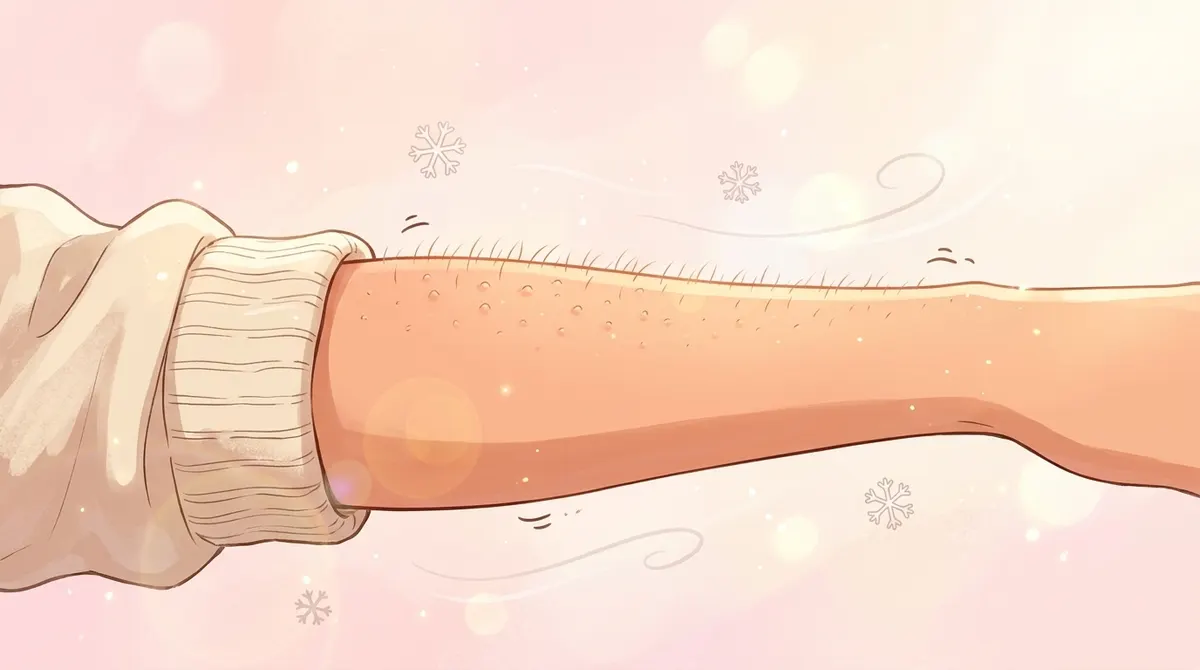
Goosebumps are a skin reflex. Each bump marks a spot where a tiny muscle has pulled on a hair. That muscle is the arrector pili, a bundle of smooth muscle fibers that attaches to a bulge on the side of the hair follicle and runs at an angle to a point just below the top layer of skin.[1]
When the muscle contracts, the hair stands up and the skin rises slightly around it. The scientific name for this is piloerection.[1]
What Tells the Muscle to Contract?
The signal comes from the sympathetic nervous system, a part of the nervous system that works without conscious control and responds to perceived danger.[6] It is well established that sympathetic nerves supply the arrector pili muscles.[4]
Different triggers reach those nerves by different routes. Researcher Jonathon McPhetres describes separate sensory pathways for cold, touch, and things we see and hear, which then converge on the same outgoing fibers.[4] That helps explain how a chilly room and a movie scene can produce the same bumps. The bumps may match, but the rest of the body's response can differ. In his study, videos came with stronger signs of sympathetic arousal, while touch came with stronger signs from the body's parasympathetic system.[4]
Why Do Cold, Fear and Music All Set Them Off?
Cold is the classic trigger.[1] In McPhetres's 2024 study of eight adults, which logged 1,198 episodes, a room averaging about 16.4°C (about 62°F), ice packs, light touch and videos were about equally likely to cause goosebumps. Cold tended to produce a more widespread response, while touch was more specific to one location.[4]
Fear fits the same system, since sympathetic nerves respond to perceived danger.[6] The most direct study we read on this was done in mice, which showed raised fur after conditioned fear.[8] That is a mouse result, and it does not measure how often frightened people get goosebumps.
Music is the odd one. In a 2011 study, 50 psychology students listened to music and to audio from films while a camera watched one spot on the forearm. Visible goosebumps appeared at least once in 40% of the students and in 18% of trials. Film audio did better than music, at 24% of trials versus 11%.[5]
Why sound does this is still debated, and two ideas stand out:
- A sad, moved state. The 2011 authors thought their measurements fit best with a link to sadness and social loss, and they called goosebumps an indicator of being moved or touched.[5]
- Surprise. An explainer from the Society for Neuroscience's BrainFacts site says musical goosebumps are typically caused by the unexpected, such as a sudden new instrument or a jump in volume.[6]
These are hypotheses, and neither one is a settled mechanism.
What Did Goosebumps Do for Furry Animals?
The usual evolutionary explanation is that the reflex made more sense when our ancestors were hairier.[6] Across mammals, raised hair shows up in two main settings.[4]
The first is warmth. Raised hair traps a layer of air that works as insulation, so a thick coat becomes a better blanket.[2]
The second is display. Piloerection is noticeable in mammals during threats and mating displays.[4] A review focused on mouse behavior describes aggression as promoting raised fur and rearing, which increase an animal's apparent size.[7]
Humans have kept the muscles without the thick coat. The story of how that happened is an inference from living animals and anatomy, because nobody can watch the reflex in our ancestors.
Are Goosebumps Useless in Humans?
Researchers do not all agree. The authors of a 2020 paper in Cell write that piloerection has lost its role in thermoregulation in humans.[2] McPhetres argues instead that it is not simply vestigial and is better understood as a reflexive response to changes in the environment.[4] He also reports that skin temperature fell before episodes and rose during them, while stating clearly that his results do not show goosebumps caused those changes.[4] With eight participants, that study is a starting point and cannot settle the question.
How Are Goosebumps Linked to Hair Follicle Stem Cells?
That same 2020 Cell paper, from a team led by Harvard's Ya-Chieh Hsu, found a second job for the goosebump machinery. The experiments were done mainly in mice.[2][3] Here is what the team reported:
- The nerve reaches past the muscle. Sympathetic nerve fibers extended to the hair follicle stem cells and formed what the authors call synapse-like connections, based on what the structures looked like under the microscope.[2]
- The muscle acts as a bridge. When researchers removed the muscle in mice, the nerve's connection to the stem cells was lost.[2][3]
- The nerve's chemical signal matters. Without signaling from norepinephrine, the stem cells in mice slipped into a deep dormancy.[2]
- Cold had a short-term and a longer-term effect. Mice kept at 5°C (41°F) for two hours showed more sympathetic activity and more norepinephrine in the skin. Mice kept there for two weeks entered the hair growth phase early, compared with mice housed at 30°C (86°F).[2]
Harvard's summary describes this as two layers: goosebumps in the short term, stem cell activation in the long term.[3]
The paper also offers a possible answer to why mammals keep this muscle. The authors suggest it may be conserved because it acts as a hub that attracts and maintains sympathetic nerves in the skin.[2] They present this as a possibility. The same arrangement of nerve, muscle and follicle exists in humans, but that anatomical similarity alone does not show that it works the same way in people.[2]
Myths vs Facts
| Myth | Fact |
|---|---|
| Goosebumps only happen when you are cold. | Touch and videos triggered them about as often as cold in one small study.[4] |
| Music gives everyone goosebumps. | Only 11% of music trials produced visible goosebumps in one camera-based study.[5] |
| Scientists agree goosebumps do nothing in humans. | Researchers disagree about whether the reflex is purely vestigial.[4][2] |
| The stem cell research is about regrowing human hair. | The cold and muscle experiments here were done in mice and do not point to any treatment.[2] |
What We Still Can't Tell You
We did not run any experiments for this article. We are summarizing other people's published work, and much of it has real limits.
The hair follicle findings come mainly from mice. They do not show that cold or goosebumps change hair growth in people, and nothing here suggests a treatment for hair loss. The human goosebump studies are small: one had eight participants, and the music study used a convenience sample of 43 women and 7 men, measured at one spot on the forearm.[4][5] Those numbers will not transfer neatly to everyone.
We also cannot tell you why one particular song gives you goosebumps, or exactly why evolution kept this reflex. Those questions remain open.
This article explains biology and is not medical advice. If you notice unusual symptoms, ask a qualified professional.
Frequently Asked Questions
Why can a song give you goosebumps?
Nobody knows for sure. One study linked goosebumps from sound to the feeling of being moved, and a neuroscience explainer points to surprises such as a sudden change in volume. Both are hypotheses. In that same study, music produced visible goosebumps in only 11% of trials.
Do animals get goosebumps too?
Mammals have the same basic reflex, though on a furry animal you see raised fur instead of bumps. Raised hair can trap insulating air, and it also appears during threats and mating displays.
Do goosebumps make your hair grow?
That has not been shown in people. A 2020 study found that long cold exposure made hair growth start early in mice, through the same nerve involved in goosebumps. It does not suggest a treatment for hair loss, and this article is not medical advice.
References
- Martel JL, Miao JH, Badri T, Fakoya AO. Anatomy, Hair Follicle. StatPearls Publishing, NCBI Bookshelf (2024). Accessed Nov 1, 2026.Supports: The arrector pili is a bundle of smooth muscle fibers attached to the follicle bulge and running obliquely to just below the epidermis; contraction raises hair and skin; responds to cold or emotional stimuli.
- Shwartz Y, Gonzalez-Celeiro M, Chen CL, et al.. Cell Types Promoting Goosebumps Form a Niche to Regulate Hair Follicle Stem Cells. Cell (2020). Accessed Nov 1, 2026.Supports: Mainly in mice: sympathetic nerves form synapse-like contacts with hair follicle stem cells and act through norepinephrine, the muscle maintains that innervation, and cold at 5°C activates this pathway. Also: raised hair traps insulating air.
- Lau J. Getting to the bottom of goosebumps. Harvard Gazette (2020). Accessed Nov 1, 2026.Supports: Harvard's summary of the mouse study: the muscle is the structural bridge, removing it loses the nerve connection, and cold gives a short-term goosebump response and a long-term stem cell response.
- McPhetres J. Diverse stimuli induce piloerection and yield varied autonomic responses in humans. Biology Open (2024). Accessed Nov 1, 2026.Supports: Eight adults, 1,198 episodes: thermal, tactile and audio-visual stimuli were about equally effective; sympathetic nerves supply the muscle; piloerection occurs in mammalian threats, mating displays and thermoregulation; the author argues it is not purely vestigial.
- Benedek M, Kaernbach C. Physiological correlates and emotional specificity of human piloerection. Biological Psychology (2011). Accessed Nov 1, 2026.Supports: Fifty students, optically measured on the forearm: goosebumps in 40% of participants and 18% of trials, 24% for film audio and 11% for music; pattern interpreted as a state of being moved or touched.
- Richardson MW. What Causes Goosebumps?. BrainFacts.org, Society for Neuroscience (2019). Accessed Nov 1, 2026.Supports: The sympathetic nervous system responds to perceived danger; piloerection is a holdover from when we were hairier; goosebumps from music are typically caused by the unexpected.
- Stowers L, Cameron P, Keller JA. Ominous Odors: olfactory control of instinctive fear and aggression in mice. Current Opinion in Neurobiology (2013). Accessed Nov 1, 2026.Supports: Aggression promotes piloerection and rearing, which increase apparent size.
- Masuda Y, Suzuki M, Akagawa Y, Takemura T. Developmental and pharmacological features of mouse emotional piloerection. Experimental Animals (1999). Accessed Nov 1, 2026.Supports: Mice given conditioned fear stress showed emotional piloerection.

Dr. Pippa is a fictional animated character who guides you through the science. She is not a real doctor or researcher.