Can You Put Aluminum Foil in the Microwave?
Quick answer
Usually no. Foil reflects microwaves, so food beneath it can heat unevenly, and crumpled foil can spark. The USDA says small, smooth pieces can be safe if your oven's manual allows them, but the FDA generally advises against foil. If your manual doesn't specifically allow it, leave it out.
In this article
- Why Does Aluminum Foil Spark in a Microwave?
- Why Doesn't the Metal Inside the Microwave Spark?
- Does Foil Just Spark, or Does It Also Ruin Your Food?
- Who Says What About Foil in the Microwave?
- How Do You Use Foil Safely If Your Manual Allows It?
- What Should You Do If It Sparks or Catches Fire?
- Myths vs Facts
- What We Still Can't Tell You
Why Does Aluminum Foil Spark in a Microwave?
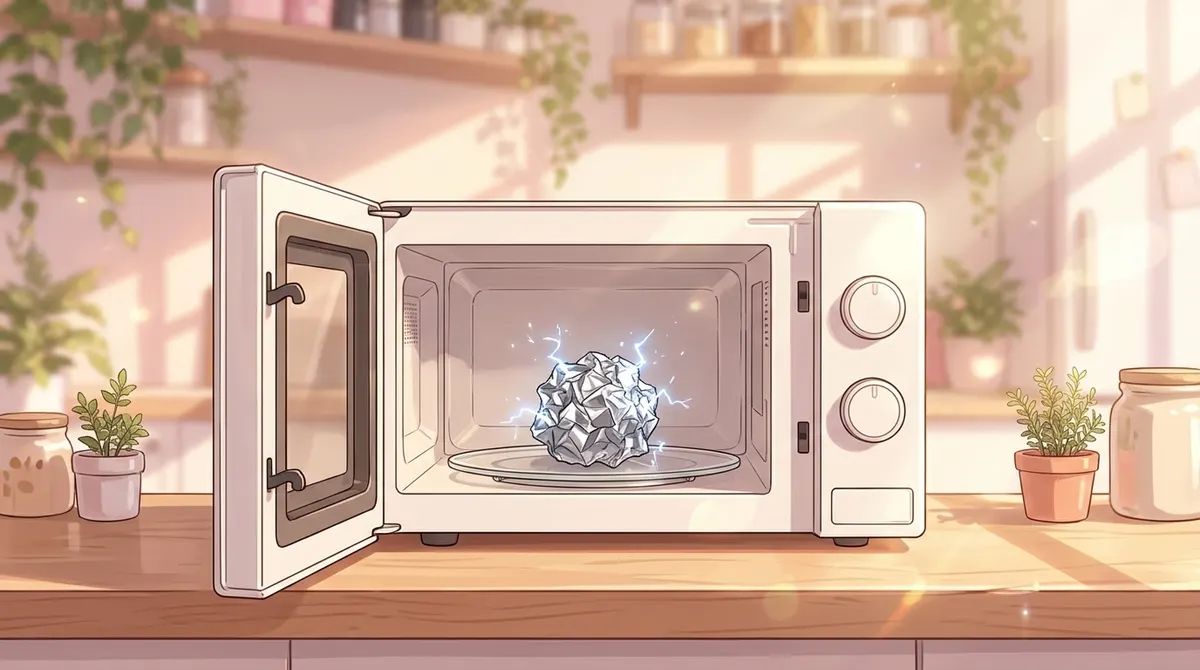
Foil sparks because microwaves push electric charge around in metal, and that charge piles up at sharp points. When the electric field at a point gets strong enough, the air around it breaks down and a tiny arc jumps across. Crumpled foil is full of those points.
A microwave oven relies on three behaviors: metal reflects microwaves, glass and most plastics let them pass, and food absorbs them.[1] Foil belongs firmly in the first group, so it does nothing useful for heating and can cause trouble.
The trouble depends on shape. Researchers studying metal in microwave fields describe it this way: charge does not spread evenly over a metal surface, and at sharp edges and tiny irregularities the electric field can reach very high values. That can break down the surrounding material and produce a spark or an arc.[3]
Electrical engineer Mark Golkowski of the University of Colorado Denver calls this "local field enhancement" and compares it to a lightning rod on a house.[4] Nuclear engineering professor John Foster describes the resulting spark as a "mini-lightning bolt."[4]
Why Doesn't the Metal Inside the Microwave Spark?
The inside of the oven is metal too, and it is supposed to be. Microwaves bounce off those walls on their way to the food.[1]
Shape is a big part of the difference. Golkowski says a big, flat, smooth piece of metal with no sharp edges probably would not have any effect.[4] That is also why a smooth patch of foil behaves so differently from a crumpled ball, even though it is the same material. Reynolds, the foil maker, lists crumpled foil, sharp edges and foil touching the oven walls as the situations that make sparks more likely.[5]
Does Foil Just Spark, or Does It Also Ruin Your Food?
Sparks get the attention, but uneven cooking is the more common problem. Because foil reflects microwaves, the food underneath it gets less energy. The FDA warns that this can make food cook unevenly and may damage the oven.[1]
Uneven heating matters for food safety as well as taste. A foil-covered section can stay cooler than the rest of the dish, so check that the food is heated all the way through.
Who Says What About Foil in the Microwave?
The experts do not fully agree, which is why you see so many conflicting answers online. Their positions are closer than they first appear: all of them treat foil as something to avoid unless a specific instruction allows it.
| Source | Position |
|---|---|
| U.S. FDA | Generally, foil should not be used in a microwave oven.[1] |
| USDA Food Safety and Inspection Service | Small amounts can be safe if your oven's manual allows it.[2] |
| Reynolds (foil manufacturer) | Reynolds Wrap is not microwave-safe.[5] |
The simplest rule is to follow your oven's manual. If it does not specifically allow foil, leave the foil out.
How Do You Use Foil Safely If Your Manual Allows It?
The USDA's guidance applies to small pieces used as a shield, such as covering chicken wing tips so they do not overcook.[2] If your manual permits this, the USDA's limits are:
- Cover no more than one quarter of the food, and never wrap the food completely.
- Use new, smooth foil, because wrinkled foil can cause arcing.
- Shape the foil smoothly to the food so no edges stick out.
- Keep the foil at least one inch from the oven walls.
- Keep it away from any metal shelf or metal turntable.
For food sold in a foil container, read the package. The USDA says some of these containers can be safe, depending on the manufacturer's heating instructions.[2]
What Should You Do If It Sparks or Catches Fire?
If you see sparks, stop the oven right away and remove the foil once it is safe to do so.[2]
If something catches fire, keep the door closed, turn the oven off and unplug it from the wall.[6] Do not open the door until the fire is out.[7] If it does not go out, leave the building and call the fire department. Have the oven checked before you use it again.
Safety note: Please do not try this as an experiment. Sparks can damage the oven and start a fire, and we have not run any tests of our own for this article.
Myths vs Facts
| Myth | Fact |
|---|---|
| Any metal in a microwave will spark. | Shape matters. Sharp points and edges are the main trigger, and the oven's own interior is metal.[3] |
| Foil is always dangerous, no matter what. | The USDA allows small, smooth pieces when the manual permits them.[2] |
| If there are no sparks, foil is working fine. | Foil still reflects microwaves, so the food beneath it can heat unevenly.[1] |
What We Still Can't Tell You
We cannot give you a safe size or time for your oven, because that depends on the oven and the foil. The research on sharp edges cited here used metal powder in a sealed laboratory microwave reactor, not foil in a kitchen oven.[3] The basic physics carries over, but those numbers do not. Likewise, the lightning rod comparison comes from experts explaining why vegetables can spark, not foil specifically.[4]
Frequently Asked Questions
Can foil in a microwave start a fire?
It can. Reynolds lists fire as a hazard of microwaving foil, along with sparks and oven damage. If a fire starts, keep the door closed, turn the oven off and unplug it.
Can you microwave food in a foil takeout container?
Only if the package or container instructions say so. The USDA says some foil containers can be safe, so check the heating instructions. If there are none, move the food to a microwave-safe dish.
Why did my microwave spark with no foil inside?
Sparks do not always need foil. Some vegetables can spark because of their shape and mineral content, according to scientists interviewed by NPR. If you cannot find a cause, stop using the oven and have it checked.
References
- Microwave Ovens. U.S. Food and Drug Administration (2023). Accessed Nov 1, 2026.Supports: Metal reflects microwaves, glass and plastic pass them, food absorbs them; foil generally should not be used because food can cook unevenly and the oven can be damaged.
- Cooking with Microwave Ovens. USDA Food Safety and Inspection Service. Accessed Nov 1, 2026.Supports: Small amounts of foil can be safe per the oven manual, with limits on coverage, wrinkles and distance from walls and metal; some foil containers can be safe.
- Chen W, Gutmann B, Kappe CO. Characterization of Microwave-Induced Electric Discharge Phenomena in Metal-Solvent Mixtures. ChemistryOpen (2012). Accessed Nov 1, 2026.Supports: Surface charge depends on shape; at sharp edges the field can reach very high values and cause sparks or arcs. Measured with metal powder in a laboratory reactor.
- Ross E. Snap, Crackle, Kale: The Science Of Why Veggies Spark In The Microwave. NPR (2016). Accessed Nov 1, 2026.Supports: Experts explain sparking as local field enhancement, like a lightning rod, and say flat smooth metal probably would not spark.
- Can You Microwave Aluminum Foil?. Reynolds Brands (2026). Accessed Nov 1, 2026.Supports: Reynolds Wrap is not microwave-safe; crumpled foil, sharp edges and contact with oven walls make sparks more likely.
- Microwave Oven Safety Tips. National Fire Protection Association. Accessed Nov 1, 2026.Supports: In a microwave fire, leave the door closed, turn the oven off and unplug it.
- Pictograph: Microwave Oven Safety. U.S. Fire Administration. Accessed Nov 1, 2026.Supports: Never open the microwave door until the fire is out.

Dr. Pippa is a fictional animated character who guides you through the science. She is not a real doctor or researcher.