Why Does Ice Float?
Quick answer
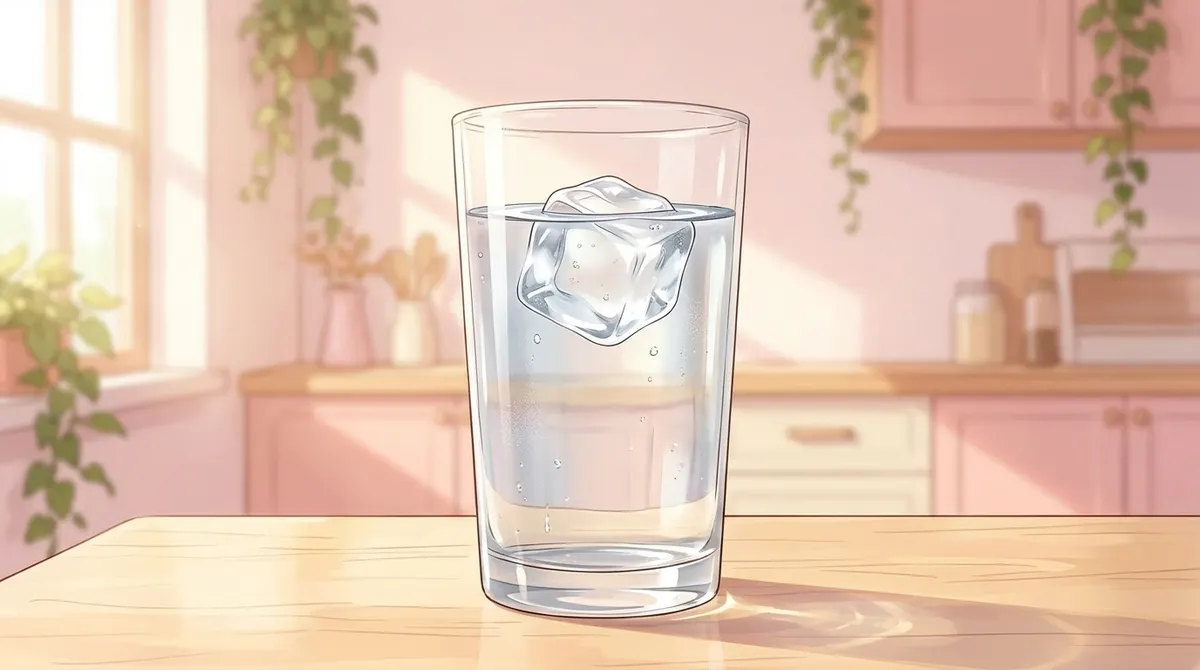
Ice floats because hydrogen bonds lock its molecules into an open crystal, so ice is less dense than liquid water: about 0.917 versus 1.000 grams per cubic centimeter at 32°F (0°C). By that arithmetic, about 92 percent of a floating ice cube sits below the surface, and about 8 percent stays above.
In this article
Why Is Ice Less Dense Than Liquid Water?
Ice floats because the same amount of water takes up more room as a solid than as a liquid. More room for the same mass means lower density, and an object less dense than the fluid around it floats.[7]
The extra room comes from how water molecules hold on to each other. Water is a polar molecule, so neighboring molecules weakly attract one another through hydrogen bonds.[5] In ice, each interior molecule makes hydrogen bonds with four neighbors, accepting two and donating two.[3] That fixed geometry builds a hexagonal lattice with a relatively open structure, including hexagonal channels running through it.[3][4]
When ice melts, only some of those bonds break. The lattice collapses somewhat, the channels partly fill, and the molecules can get a little closer together on average.[3][4] Most compounds go the other way and are denser as solids.[6]
How Dense Are Ice and Water?
Density here is in grams per cubic centimeter (g/cm³), which is the same as grams per milliliter.
| Substance | Temperature | Density (g/cm³) |
|---|---|---|
| Ice | 32°F (0°C) | 0.9167[2] |
| Liquid water | 32°F (0°C) | 0.99987[1] |
| Liquid water | 39.2°F (4°C) | 1.00000[1] |
| Liquid water | 50°F (10°C) | 0.99975[1] |
| Liquid water | 70°F (21°C) | 0.99802[1] |
The gap between ice and water is far bigger than the gaps among the liquid rows. Divide the two 32°F values, 0.99987 ÷ 0.9167, and you get about 1.09. So freezing makes water take up about 9 percent more space, which matches the figure the USGS and a Penn State course give.[1][6]
How Much of an Ice Cube Sits Below the Surface?
A floating object sinks until it has pushed aside its own weight of fluid.[7] That leads to a tidy rule: the fraction under the surface equals the object's density divided by the fluid's density.[7]
Using the table above for ice in water at the freezing point:
- Fraction below the surface: 0.9167 ÷ 0.99987 ≈ 0.917, or about 91.7 percent.
- Fraction above the surface: 1 − 0.917 = 0.083, or about 8.3 percent.
- For an ice cube 1 inch (25.4 mm) tall, floating flat: about 0.92 inches (23 mm) below and 0.08 inches (2 mm) above.
Warmer water barely changes the answer. In 50°F (10°C) water, 0.9167 ÷ 0.99975 still rounds to 0.917.
The USGS rounds more loosely and says about 10 percent of an ice cube or iceberg sits above the water line. It also notes that ice density varies because ice can contain air.[1] Seawater adds another wrinkle. It has a density of about 1.027 at 32°F (0°C) and 3.5 percent salinity, and freshwater ice is about 0.92 by the same reference.[8] That gives 0.92 ÷ 1.027 ≈ 0.90, so ice made from fresh water shows closer to a tenth of its volume in the ocean.
Why Is Water Densest Near 39°F (4°C)?
Two effects pull in opposite directions as liquid water warms from its freezing point. Warming breaks more hydrogen bonds, which lets the remaining open structure keep collapsing, so the volume shrinks. Warming also makes molecules move more, which pushes them apart.[4]
Below the peak, the first effect wins. Above it, the second one does.[4][5] The crossover comes at 3.98°C, or about 39.2°F.[5]
The peak is gentle. The Open University gives about 999.86 kg/m³ at 32°F (0°C), almost 1000.0 at about 39°F (4°C) and 999.73 at 50°F (10°C).[5] From 32°F to 39.2°F, density changes by only about 0.013 percent, using the USGS values above. That tiny difference is still enough to arrange a whole lake.
What Does This Mean for Frozen Lakes?
A lake cools in stages, as described in an Open University course:[5]
- In fall, surface water cools, gets denser and sinks, and warmer water rises to replace it.
- This continues until the whole lake reaches about 39°F (4°C).
- Further cooling makes the surface water less dense, so it stays on top instead of sinking.
- The surface reaches 32°F (0°C) and ice forms there.
The ice then acts as an insulator between the water and the winter air, which keeps the water below from freezing solid and gives aquatic life a refuge.[10][9] Penn State's course says deep water in large temperate lakes such as the Great Lakes stays near 39°F (4°C).[6]
The USGS points out the alternative: if water were densest at its freezing point, cold surface water would sink in winter and a lake could freeze from the bottom up.[1] Sinking ice would also leave the surface exposed to cold air, so the water would freeze much faster.[4]
A frozen lid has a cost, though. Snow and ice block light and keep oxygen from entering from the air, so oxygen can fall to very low levels in a pond, and low oxygen is a common cause of winter fish kills.[9]
Safety note: Floating ice is not the same as safe ice. The National Weather Service says ice is never 100% safe.[14] It says to stay off ice under 2 inches thick and gives 4 inches as the minimum for walking, for new, clear ice only. White or "snow" ice is about half as strong, so it doubles those numbers. Stay off ice with cracks, holes or flowing water around its edges, or ice that has thawed and refrozen.[13] Thickness also varies across a single body of water.[15] As the Weather Service puts it, if you don't know, don't go.[14]
Myths vs Facts
| Myth | Fact |
|---|---|
| Ice floats because it is colder than the water. | Ice floats even in water at the same temperature, because at 32°F (0°C) ice is less dense than liquid water.[2] |
| Colder water always sinks. | Only down to about 39°F (4°C). Water colder than that is less dense and stays near the surface.[1] |
| All the hydrogen bonds break when ice melts. | Only some break, which is why the liquid is only a bit denser than ice.[3] |
| All ice floats. | "Heavy ice" made from heavy water is denser than normal water and sinks in it.[1] |
What We Still Can't Tell You
We ran no experiments for this article. The numbers come from published references, and they describe clean water and ice, not the cube in your glass. Bubbles, dissolved material and the liquid you drop it in can all shift the result, so treat 91.7 percent as a good estimate, not a measurement of your drink.
The simple "ice is an open lattice, liquid is a looser version" story is also a simplification. Researchers still debate the details of liquid water's structure. The classical picture has mostly four-coordinated molecules, while some X-ray spectroscopy work has been read as suggesting only two strong hydrogen bonds per molecule.[11]
Lakes do not all follow the tidy four-step story either. A 2026 paper cites ample evidence of ice-covered lakes with bottom sediments cooler than 3.98°C (about 39.2°F), and notes that warmer bottom temperatures have been reported in places including Tibetan lakes and the Great Lakes.[12] And nothing here can tell you whether a particular lake is safe to walk on today.
Frequently Asked Questions
Why does water burst pipes when it freezes?
Water takes up about 9 percent more space as ice. That expansion pushes hard enough to burst pipes and widen cracks in rock, according to a Penn State course on water.
Does a lake freeze from the top down?
Normally, yes. Once surface water cools below about 39°F (4°C), it is less dense than the water beneath it, so it stays at the top and freezes there. The ice then insulates the water below.
Does ice float in every liquid?
No. An object floats only in a fluid denser than it is. Ice floats in water because it is less dense than water, but that comparison has to be made again for any other liquid.
References
- Water Density. U.S. Geological Survey, Water Science School. Accessed Nov 1, 2026.Supports: Table of water density by temperature; density drops about 9 percent on freezing; ice density varies with trapped air; about 10 percent of ice sits above the water line; water near 4°C is denser than water at 0°C, and if water were densest at freezing a lake could freeze from the bottom up; heavy ice sinks in normal water.
- LeeH. Density of Ice. Physics Van, University of Illinois (2013). Accessed Nov 1, 2026.Supports: At 0°C, ice has a density of 0.9167 g/cm³ and is less dense than liquid water, so it floats.
- Cronk JD. CHEM 245: Water. Gonzaga University (2017). Accessed Nov 1, 2026.Supports: In ice each interior molecule makes hydrogen bonds with four neighbors, forming a relatively open hexagonal lattice; melting disrupts some bonds so molecules can approach a little more closely.
- Ice and Water (CHEM 210D: Modern Applications of Chemistry). LibreTexts, Duke University course text. Accessed Nov 1, 2026.Supports: Hydrogen bonding gives ice an open structure with hexagonal channels; on melting the lattice partly collapses; warming above 0°C shrinks the volume until molecular motion pushes molecules apart by about 4°C; if ice sank, water would freeze much faster.
- The oceans: 3.2 The density of fresh water and seawater. The Open University, OpenLearn. Accessed Nov 1, 2026.Supports: Fresh water reaches maximum density at 3.98°C (about 999.86 kg/m³ at 0°C and 999.73 at 10°C); hydrogen bonds between polar molecules produce ordered packing that lowers density; describes how a lake cools, mixes and then forms surface ice.
- Arthur M, Saffer D, Belmont P. Thermal Expansion and Density (EARTH 111: Water: Science and Society). Penn State College of Earth and Mineral Sciences. Accessed Nov 1, 2026.Supports: Most compounds are denser as solids; ice occupies about 9 percent more volume than water; deep water in large temperate lakes such as the Great Lakes stays near 4°C; freezing can burst pipes and widen rock cracks.
- Moebs W, Ling SJ, Sanny J. 14.4 Archimedes' Principle and Buoyancy, University Physics Volume 1. OpenStax, Rice University (2016). Accessed Nov 1, 2026.Supports: The buoyant force equals the weight of the displaced fluid; for a floating object, fraction submerged equals object density divided by fluid density.
- Some useful facts about water and ice. Food and Agriculture Organization of the United Nations. Accessed Nov 1, 2026.Supports: Sea water has a density of 1.027 kg/l at 0°C and 3.5 percent salinity; freshwater ice has a density of 0.92 kg/l at 0°C.
- Lefringhouse A. Under the Ice: What Winter Means for Your Pond. University of Illinois Extension (2025). Accessed Nov 1, 2026.Supports: Ice and snow insulate the water below; they also block light and oxygen exchange, and low dissolved oxygen is a common cause of winter fish kills.
- Wilhelm F. What Happens Beneath the Ice?. University of Idaho, Idaho Water Resources Research Institute (2022). Accessed Nov 1, 2026.Supports: Ice insulates the water below from extreme air temperatures, which keeps the water from freezing solid and gives aquatic life a refuge.
- Cipcigan F, Sokhan V, Martyna G, Crain J. Structure and hydrogen bonding at the limits of liquid water stability. Scientific Reports (2018). Accessed Nov 1, 2026.Supports: The classical picture of mostly four-coordinated molecules has been challenged by X-ray spectroscopy results suggesting only two strong hydrogen bonds per water molecule.
- Estay G, Noto D, Ulloa HN. Under-ice convective regimes driven by sunlight and sediment temperature control water-ice heat flux. PNAS Nexus (2026). Accessed Nov 1, 2026.Supports: There is ample evidence of ice-covered lakes with sediment temperatures below 3.98°C, while bottom temperatures above 3.98°C have been reported in lakes including Tibetan lakes and the Great Lakes.
- Ice Storms. U.S. National Weather Service. Accessed Nov 1, 2026.Supports: Stay off ice under 2 inches thick; 4 inches or more for walking; white ice is about half as strong as new clear ice, so double the guidelines; do not go out on ice with cracks, flowing water or refreezing.
- Social Media: Cold and Winter Hazards. U.S. National Weather Service. Accessed Nov 1, 2026.Supports: Ice is never 100% safe; minimum thickness guidelines apply to new, clear ice only.
- Ice Safety. New York State Division of Homeland Security and Emergency Services. Accessed Nov 1, 2026.Supports: Ice is never 100% safe, and its thickness varies across a body of water.

Dr. Pippa is a fictional animated character who guides you through the science. She is not a real doctor or researcher.